

Hi, Ian. What part did you play in helping Investec come to be?
I was there from day one. What is clear to me with hindsight is that the fact that I could start Investec and that it has survived for so long is all largely based on pure chance. Nothing was predictable or guaranteed.
I worked at IBM as a salesman, Lease Plan International (LPI) as an assistant to the Chairman and The University of the Witwatersrand where I taught Business Finance part time. LPI was sold at the end of 1973 to the Nedbank Group. I let my Chairman know that I would be leaving, as I had no intention of ever working for a bank. He invited me anyway to the Christmas party that same evening, at the Sunnyside Hotel, from which I moved a bit later to the IBM Christmas party in the next room. From there I went onto the NCR Christmas party. Here, by chance, I bumped into a former prospect from my IBM time, Michael Lewis - Chairman of Incorporated General Insurances (IGI). Both of us were very much the worse for wear.
Michael kindly asked what I was doing. I told him that I had that day resigned from LPI and was at that moment officially unemployed. He immediately asked if I would be interested in the role of Investment Manager for IGI. I was sure he was being polite and thought that we would both laugh it off. However, early the next morning, a letter was delivered to me announcing my appointment as IGI Investment Manager which indicated that I should be at their offices by 11am. I felt the least I could do was to go there. Almost to my own surprise, I agreed to stay.
Shortly later, on 24th March 1974, we agreed to start a leasing company. We registered the leasing company, called Hosken Consolidated Leasing, after the IGI holding company, Hosken Consolidated Investments (HCI), founded by the Hosken family who were from Wales.
Errol Grolman soon joined the company, as did Linda Busansky. Two years later, the group was restructuring and agreed to sell the leasing company to us for R1000 and to allow us to pay off the loan in the company by running down the leasing book. We also borrowed money to start writing new business. Larry Nestadt joined us as a co-shareholder at that time, and we changed the name to Investec.
A few years later, Stephen Koseff and my brother, Bernard Kantor, as well as our then auditor, Glynn Burger joined the team, which became the basis of Investec.
What was it like in those very early days of Investec? Was it exciting? Thrilling? Nerve wracking?
The short answer is that it was all of the above. There was an energy and belief in the team that allowed us to feel that we could meet any challenge.
One particularly nerve-racking challenge was when the Central Bank wrote to us saying that we had contravened the Banks Act. Together with our lawyer, Joe Rabinowitz, I went to see the Registrar of the Reserve Bank, where he informed me that luckily, I had a very clever lawyer and that we were no longer in contravention. However, he then said that he would change the regulations so that we would remain in contravention.
It became clear to us that we would need to become a bank. We knew full well that there would be no new banking licenses issued, and certainly not to us.
Stephen and Larry set about writing to every bank in the country asking whether they were for sale. With no result. Shortly after we were contacted by Cape Trustees and Executors, by chance the only people we had not written to and who had a full banking licence, which we had not realised. They had an urgent problem and needed help. I went to Cape Town to meet the CEO, Andre de Villiers Joubert, and asked Stephen to join me. We did a full and thorough investigation of the business in a very short space of time and the books were immaculate.
Back in Johannesburg we all agreed that we should buy Cape Trustees. Larry, Stephen and I went back to Cape Town on 17 May 1980 to conclude and we sat in row 17 on the plane. Stephen recalls Larry saying that we were going to get the deal as 17 was his lucky number. Our problem was solved. And we were fortunate once again that Michael Lewis, Hosken Consolidated Investments, gave us support by partially financing the purchase.
What do you miss most about those very early days?
The process of building the bank was not without its challenges. We were all strong minded and found it difficult to avoid the “I told you so” and “you should have done it this way” comments, and from there came the system where we would sit down at 7am every morning after gym with our toasties. We would discuss and make decisions on the basis that everyone was “in”. I had a diary and on the right-hand side I wrote down what we had agreed, below that was another list, yet to be agreed. If we left anybody “out”, it would not work.
How do you describe the Investec culture?
To make it work we were forced to find full agreement, unanimity. The idea was that we, and ultimately any team of about six people, responsible for a decision, could make any decision, as long as it was unanimous. Searching for unanimous agreement became the basis of what we refer to as the Investec culture.
This was not always harmonious; in fact it was very seldom harmonious. We all had broadly the same goals, but different ideas about how to achieve them. The discussions were tough. Along the way we found ways of improving the process and also had excellent facilitators who would help us.
I am sure there are better ways of making decisions. What I do know is that when we made a decision, it stuck and we all backed it.
At the time there was also a lot of talk about values which was a difficult thing to work with. Values were about belief whereas we were more concerned with how we behaved with each other and others around us.
The process of finding agreement became the driver at Investec for getting things done and also getting them done in innovative ways with a particular impact on improving the level of service to clients. It also had the effect of locking us in, not to the company per se, not even to each other, but to the idea of what we were doing, which meant that in the end most of us stayed involved with Investec for a very long time as many colleagues still do. We had all started with Investec when we were in our twenties and went on to spend many decades there, almost our entire working careers, which is a huge testimony to the power of the Investec culture.
Over those early years, the contribution of various team members to the foundations of Investec became very clear. For Errol, it was understanding the difference between right and wrong and the need to be fair and reasonable. Larry gave us the understanding that the client came first and to this day that remains at the heart of the relationships that Investec has with its clients. This attitude allowed us to compete with our then major competitor-colleagues, Rand Merchant Bank. Bernard and Stephen were the challengers; they gave us the understanding of the need for robust discussion and helped us to extend the limits of our thinking. Glynn was “true grit”, when everyone around him had fallen, Glynn was still going. And Linda was the organiser and had all the keys, and was the one person none of us would challenge. While the people may have changed, I like to think that these foundations for Investec remain the same.
I was recently sent the following graphic by a colleague of mine from another board which I thought was a pretty accurate summary, though I have no idea who commissioned this!
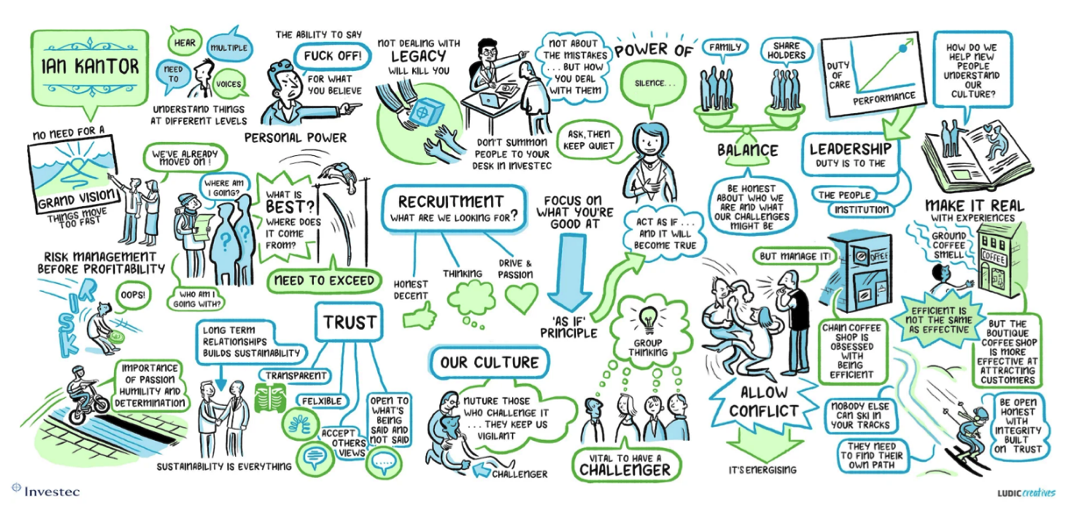
Visual courtesy of Ludic Media Studio
We were fortunate to be joined over the years by thousands of outstanding colleagues, outstanding non execs as well as outstanding Chairmen, in Michael Lewis, followed by Bas Kardol, Hugh Herman, Perry Croswhaite, Fani Titi now Group CEO, and the current chairman, Philip Hourquebie.
I am wholly committed to the idea that in any business, culture comes first, and it is the culture that determines the quality and success of the business.
I would also say that we feel that we had been very fortunate. We all feel an immense sense of gratitude, obviously to our colleagues and clients, but also being subject to their banking jurisdictions, to the countries in which the bank did and continues to operate, particularly South Africa and the UK, as well as others, for the opportunity they afforded us.